Friday, February 28, 2014

Real rain


Here in California we finally seem to have moved on from the perpetual springtime we have had all winter and have entered a more seasonal weather pattern. In the past couple of days we have had 5” of rain with more forecast for tonight. We are in the middle of what is called a pineapple express storm, which according to wikipedia is an example of an atmospheric river. Apparently these are essentially rivers in the sky, thousands of kilometers long and several hundred kilometers wide and amazingly they may carry more water than the Amazon (that’s what it says anyway!)


 Two days rain

Rain is something most people don’t give a second thought to, except as an inconvenience. It is only when it stops raining for a long period do you start to realize its importance. Having grown up in rainy England  (actually not that rainy – I get more rain in my garden here than I ever saw when growing up) I have always a hard time really appreciating the rain. It is only recently, after 10 months of almost no rain, for the first time in my life I can understand how wonderful it is, as it changes the color of the landscape from brown to green. Water falling from the sky and landing right where you want it (instead of coming from a tank through a pipe with a pump) is a near miracle. The fact that it then sits in the soil until needed by plants is equally amazing. Yet another miracle is when it falls as snow in the mountains and sits there for months before it melts and gradually runs down to us.

As gardeners we should think about the rainwater that falls on our property and where it goes. We should make sure that any rainfall that lands in our garden has a chance to soak into the soil and doesn’t run away down storm drains. Incidentally an inch of rain adds up to around 27000 gallons per acre, which at 1.5 cents per gallon adds up to around $400. I hate to quantify and put a price on nature, but I mention it to show how much she gives that we take for granted.

Wednesday, February 12, 2014

Stinging nettle time


Winter is the season for stinging nettles in my garden. Urtica dioica is considered to be the best species for food, but all native species can be used in the same ways and that includes Urtica holosericea which grows wild in my garden.

At first glance stinging nettle would appear to be an unlikely food, but to the initiated it is one of the most useful common wild foods. It is very nutritious, widely available, easy to identify, often available in abundance and it tastes good enough that it has been cultivated as a food crop. Of special importance is that it appears very early in the year (from mid winter to late spring), when few other foods are available. In fact it is only useful at this time of year, while the plants are young and up to 8 or 10” high. Not only does the plant get tough as it gets bigger and summer progresses, but inedible crystal deposits form in the leaves.  

You sometimes hear stories of people reduced to eating nettles during wartime, but this gives a false idea of them as purely a famine food. Nettles are actually extremely nutritious and in such circumstances you couldn’t eat anything better. They contain more protein than almost any other green leaf, large amounts of chlorophyll, vitamin A, several B's, lots of C and D and an abundance of minerals including calcium, iron (one of the richest plant sources), manganese, phosphorus, potassium, silicon and sulfur. All of these nutrients would be tempting to any self-respecting herbivore, which is why it has to protect itself as it does.

If you are familiar with this plant and its propensity to sting anything that touches it, you will already know that it can’t be eaten raw. In fact you will have to protect your hands with gloves (or anything that comes to hand) while gathering the young shoots and leaves. Only a few minutes cooking are enough to wilt the tiny needle like hairs that inject their poison and make it perfectly edible. A few minutes of boiling, steaming or stir-frying are necessary to produce an excellent potherb and they can be used in any recipe that calls for spinach (I like to use it in sag aloo, an Indian spinach and potato curry). They are probably the greenest thing you are ever likely to eat and will make anything a deep green color.

If you really get into nettles they can be dried and powdered for adding to bread, soups and other dishes to increase their nutritional value (and turn them bright green too).

Though you can’t eat older plants, they have been used as a source of fiber for cordage, rope, netting, paper, sail cloth, sack cloth and even fine fabrics (it was said to be better than flax).

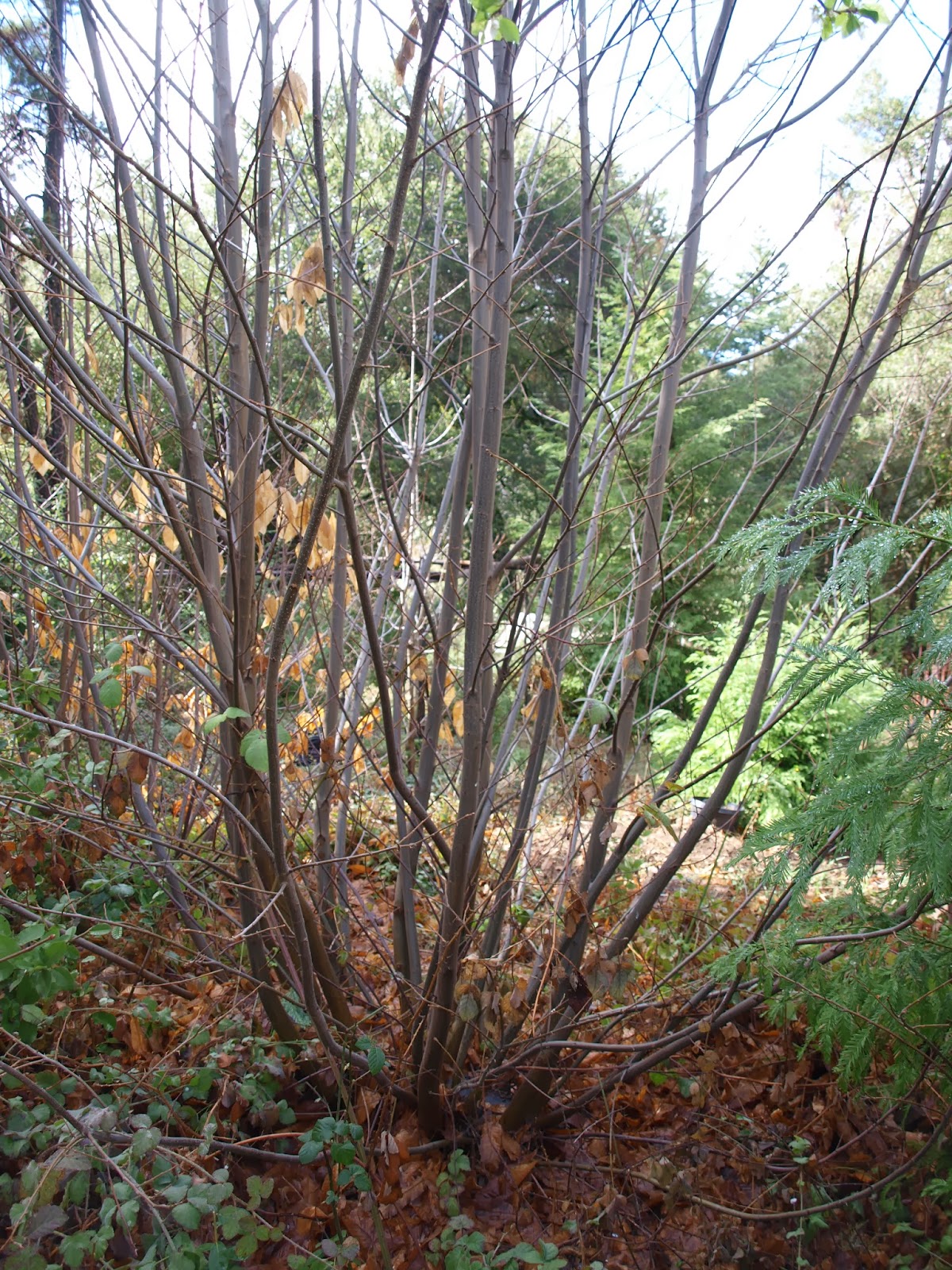
Coppicing chestnut

A lot of people seem to find this site when looking for information on coppicing, so I thought I would post a few pictures I've taken of the process of coppicing some chestnut trees in my garden (and a couple of making fence posts).


Tuesday, February 11, 2014

Hugelkultur variation


I am still developing my new vegetable garden site (which was previously a poison oak patch). The soil there is already pretty good, but I recently started a major project to improve it. This was inspired by a huge pile of half rotten wood that is taking up far too much space around a walnut tree. I have decided the best way to get rid of it, is by using it to make some hugelkultur inspired beds. I wouldn’t exactly call them hugelkultur beds because I am keeping them low (I am afraid they would lose too much water in summer if they were taller). 

Wood is actually a very good source of nutrients and energy for the soil, but is very high in carbon when new, which means it can take nitrogen from the soil during decomposition. Half rotten wood is already well on the way to being broken down, so doesn’t have this problem.

I am taking a fairly quick and easy approach to making the beds. I have been digging out 6” of soil, filling the excavation with old wood, covering it with a layer of horse manure (some fresh, some aged) and replacing the soil. This raises the bed somewhat, but I’m expecting (wanting) it to sink significantly, to leave a very slightly raised bed. I will keep doing this until I run out of wood or energy, whichever comes first.


Friday, September 6, 2013

A tree I grafted last winter


Two winters ago a large Douglas Fir tree fell in my garden and completely demolished a Santa Rosa Plum tree. The following spring shoots appeared from the rootstock and last winter I grafted a scion of a Mirabelle De Nancy plum on to the biggest of them (and removed the rest). With a well established root network the scion has grown amazingly fast and is already 8 feet tall with many branches.

If you lose a fruit tree, watch out for shoots from the root, which is often more resilient than the cultivar. If these appear you can do as I did and graft on to them.

Wednesday, September 4, 2013

The New Vegetable Growers Handbook


I’ve been away from this blog for far too long, which is unfortunate, but I do have a reasonable excuse. The extended absence is due to the fact that almost all of my writing energy for the past 9 months has been devoted to revising my previous book “The Vegetable Growers Handbook” One kind Goodreads reviewer called that book “the best, most useful guide to vegetable gardening I have ever read”, which made me feel good, but I am not one to rest on my laurels (which is good as they are pretty few and far between). I wrote that book five years ago and in the meantime  I have learned a lot more and I eventually reached the point where I was no longer so proud of the first book and felt I could do better. The result is “The New Vegetable Growers Handbook”, which isn’t the most original title, but describes it adequately enough. The new book is bigger (50% bigger), better (with more information and more plants) and hopefully will keep me happy for another five years.


My new baby

Friday, September 28, 2012

Seed saving


Saving seed from your own garden is one of the most satisfying garden activities I can think of. It is as close as you can come to getting something for nothing and is an amazing demonstration of how gardens are living, self perpetuating things (the fact that the garden produces these amazingly complex little genetic packages is as near to a miracle as most of us are ever likely to come). All you have to do is allow nature to take its course and everything you need to plant more gardens in following years is produced for you.  Doing this saves money, makes you more self sufficient, helps to preserve genetic diversity and is fun (I have also found it is the best ways to one-up other gardeners in discussions at parties because few people do it or know much about it). 
Carrot seed

Seed saving is most commonly practiced in the vegetable garden. You can plant a crop of bush beans, harvest it for weeks and then let the last pods mature and end up with more bean seed than you started with! It doesn’t have to stop with the vegetables though, I save seed from all kinds of useful plants, nitrogen fixers, biomass plants, fruiting trees and shrubs and more. It is a great way to get enough seed to grow biomass plants and nitrogen fixers on a large scale. When you have an abundance of seed you can afford to be profligate with it, scattering it wherever you think it might survive.

Seed saving sounds like it could be complicated, but it really couldn’t be much simpler. Plants are programmed to make reproduction their top priority (just like we are) and if we leave them alone they will flower and make seed (in most cases). The only part that requires some thought is keeping the varieties pure and this largely depends upon whether a plant is self-pollinated or cross-pollinated. Self-pollinated plants produce seed that is the same as their parents, whereas cross-pollinated plants produce seed that is a mix of both parents. To maintain a cross-pollinated variety it must be pollinated by another plant of the same variety. Another problem is with hybrid seed, the seed of F1 hybrids don’t usually resemble their parents, so saving it is not generally considered to be worthwhile (stick with open pollinated varieties).
Amaranth seed

The easiest plants to save seed from are the self-pollinating fruit producers, such as tomatoes, eggplants and peppers (just collect the seed before you eat them). Beans and peas and lettuce are also mostly self-pollinating and easy to deal with. Cross-pollinated crops (these include brassicas, cucurbits and corn) are a little more difficult because they need to receive pollen from another plant of the same variety. The easiest way to do this is to have only one variety of each species flowering at one time, though you could also hand-pollinate, which isn’t as hard as it sounds. You don’t want one variety getting pollinated by another or the resulting seeds will be a mix of the two.

Keeping a variety totally pure is most important if you are selling or trading it, or if you want to conserve a rare variety. If you are just using the seed yourself it isn’t necessarily essential (I use most of my lettuce seed for growing salad mixes and don’t even notice what variety it is). If a variety gets crossed and turns into something weird and unusable you can always discard it and buy new seed.
Leek seed

Saving seed has become a routine activity in my garden, whenever I see seed ripening I go out with my dishes or paper grocery bags and collect it (I tend to decide whether I actually want it after collecting it). In some cases you have to watch the ripening seed carefully, so you can get it before it is falls or is dispersed. Depending upon the plants you might collect seed directly from the plant, or you might cut the whole seed bearing top and dry it in a paper bag. I then dry the seed in a warm place (usually my greenhouse) and then clean it with various sized mesh sieves and by winnowing. I store the dry seed in regular paper envelopes in a cool dry place. Moisture is the enemy of stored seed, they must be dry when you store them and must remain dry until you use them. 

I find one of the biggest problems with seed saving is what to do with all of the seed that accumulates (plants like Amaranth and Kale can be amazingly productive). You only need a small fraction for planting your own garden, so have to find ways to use the rest. This usually means giving it away (it makes great Christmas presents), trading it, selling it, or in some cases sprouting and eating it. 
Sweet clover seed

Another bonus from allowing plants to produce seed is that some will inevitably fall and you get volunteers appearing in unexpected places. I encourage this by cleaning the seed out in the garden and scattering the emptied seed heads out in the garden (they often contain some seed). In some cases you may get so many volunteers that you don’t actually need to plant, but that’s for another post. 

If you want to save seed you need to know exactly what it is, so it is important to label the plants carefully (and write it down in your journal too). You don’t want to be in any doubt what the seed is.