Friday, July 27, 2012

Favorite gardening quotes


Here are my favorite quotes on gardening and together they sum up my garden philosophy pretty well (I like to think I belong with such illustrious company).

But if each man could have his own house, a large garden to cultivate and healthy surroundings - then, I thought, there will be for them a better opportunity of a happy family life. George Cadbury

Unemployment is capitalism's way of getting you to plant a garden.   Orson Scott Card

A man has made at least a start on discovering the meaning of human life when he plants shade trees under which he knows full well he will never sit.  D Elton Trueblood

I think this is what hooks one to gardening: it is the closest one can come to being present at creation. Phyllis Theroux 

If you have a garden and a library, you have everything you need. Marcus Cicero 

The garden suggests there might be a place where we can meet nature halfway. Michael Pollan 

We must cultivate our own garden. When man was put in the garden of Eden he was put there so that he should work, which proves that man was not born to rest.  Voltaire 

There can be no other occupation like gardening in which, if you were to creep up behind someone at their work, you would find them smiling.   Mirabel Osler

I used to visit and revisit it a dozen times a day, and stand in deep contemplation over my vegetable progeny with a love that nobody could share or conceive of who had never taken part in the process of creation.  It was one of the most bewitching sights in the world to observe a hill of beans thrusting aside the soil, or a rose of early peas just peeping forth sufficiently to trace a line of delicate green.   Nathaniel Hawthorne

I never had any other desire so strong, and so like to covetousness, as that one which I have had always, that I might be master at last of a small house and a large Garden.   Abraham Cowley  1666

When I go into the garden with a spade, and dig a bed, I feel such an exhilaration and health that I discover that I have been defrauding myself all this time in letting others do for me what I should have done with my own hands.   Ralph Waldo Emerson

The highest reward for man’s toil is not what he gets for it, but what he becomes by it.   John Ruskin

To forget how to dig the earth and to tend the soil is to forget ourselves. Mohandas Gandhi

Gardening is the purest of human pleasures.  Francis Bacon

A house though otherwise beautiful, yet if it hath no Garden belonging to it, is more like a Prison than a House.    William Coles

I want death to find me planting my cabbages.   Michel de Montaigne

A modest garden contains, for those who know how to look and to wait, more instruction than a library.  Henri Frederic Amiel

Those who labour in the earth are the chosen people of God.   Thomas Jefferson

The garden that is finished is dead.  H. E. Bates

Gardening is a labour full of tranquility and satisfaction; natural and instructive, and as such contributes to the most serious contemplation, experience, health and longevity. John Evelyn, 1666

For most of us who are intimidated by theories of garden design, the cottage garden provides immediate appeal, since it is a horticultural rather than an architectural solution to a limited area.   Patricia Thorpe

We come from the earth, We return to the earth, And in between we garden.   Author Unknown

The more help a man has in his garden, the less it belongs to him.   William M. Davies

The most serious gardening I do would seem very strange to an onlooker, for it involves hours of walking round in circles, apparently doing nothing.   Helen Dillon

The goal of life is living in agreement with nature. Zeno 335BC

And when your back stops aching and your hands begin to harden . . . You will find yourself a partner in the Glory of the Garden.   Rudyard Kipling

Our task must be to free ourselves by widening our circle of compassion to embrace all living creatures and the whole of nature in its beauty.   Albert Einstein

If you would be happy your whole life long, Become a gardener.   Old Chinese Proverb

A garden is not made in a year; indeed it is never made in the sense of finality. It grows, and with the labour of love should go on growing.   Frederick Eden

There is no such thing as an ugly garden-gardens, like babies, are all beautiful to their parents.   Ken Druse

Advice on dandelions: If you can't beat them, eat them.   Dr James Duke

In his garden every man may be his own artist without apology or explanation.   Louise Beebe Wilder

It used to be thought that our love of plants was an impractical but pure passion. But now, in the age of environmental crisis, we're discovering that gardening is essential to human life.   Jacqueline Heriteau

One of the most important resources that a garden makes available for use, is the gardener's own body. A garden gives the body the dignity of working in its own support. It is a way of rejoining the human race.   Wendell Berry

I am writing in the garden. To write as one should of a garden one must write not outside it or merely somewhere near it, but in the garden.   Frances Hodgson Burnett

The day is coming when a single carrot, freshly observed, will set off a revolution.  Paul Cezanne

Saturday, June 16, 2012

Deer

Deer have got into the garden again. About a week ago I had a vague suspicion that something was wrong when the family dog barked far more than usual one night. She was obviously trying to explain the situation to me, but I just made her come inside for the night. I first noticed something was amiss when I saw footprints across a bed of seedlings, but dismissed it as possibly being the dog (though she usually sticks to the paths). Later that day I also noticed some missing grape leaves, but I attributed that to the always destructive quail. The dog barked again the next night and was ignored again. The next day I saw the telltale stripped lower branches of a cherry tree, too high for quail, but just right for deer and I finally understood there was a problem. With my eyes newly opened I started to see damage all over: a row of tomato seedlings topped, bitten off raspberry shoots, mallow plants completely stripped and the lower branches of several apple trees gone (deer particularly enjoy apple leaves).

As I have just moved a fence line to expand my garden I assumed that the deer must be getting in through the newest part of the garden, so I spent some time going over the new fencing trying to figure out where. I strengthened some suspicious spots and hoped for the best. It didn’t work though, they got in again that night and ate some more apple tree as well as some low plum branches and various wild plants. I was awakened at dawn the next morning by the dog barking, so I let her out and she chased them away (if I was fully awake I would have tried to see where they went out). I then went over the older sections of fence and found a place where a branch had fallen and the wire had been pushed down to a point where deer could jump over. I fixed that, as well as a place where the fence had been pushed up to leave a wide gap underneath. I breathed a sigh of relief that I had finally found the problem, but they got in again that night and just about finished off one apple tree. The next day I found a well hidden spot where a falling branch from a neighbors tree had torn a hole just big enough for a deer to get through. This finally did the trick and the garden is now secure again (for the time being). 

Dogs are domesticated wolves and know more 
about deer than you do, so listen to them

One of my garden rules is that I don’t buy anything I can salvage, so my perimeter fence is an almost laughable mix of 8 or 9 different kinds of fencing, held together with wire. It is only 6ft high at its tallest and only 5 ft in many places, which is theoretically low enough for deer to jump, but they don’t. Either they are too well fed to make the effort or the fences look too hazardous to try. I suspect the latter as a broken leg would be the end of a deer.

The thing I find most interesting about this whole event is that the damage has been relatively minor compared to the last time it happened (which was four or five years ago). Then it was a major event and set back many plants significantly. The garden has grown a lot since then and many of the fruit trees are now too tall to be seriously damaged. Now I understand why trees take the shape they do (and feel grateful we don’t have giraffes around here). There is also far more vegetation around in general, so the same amount of damage isn’t nearly as significant. We have all heard that the garden gets more resilient as it matures and diversifies, and this is a real world example of this.

 I no longer get too perturbed by minor disasters like this, as you might have guessed by the length of time it took me to fix it. I don’t even feel any animosity to “the little deers”, as they are simply trying to make a living (if anything I am the interloper into their world). 

Sunday, May 27, 2012

Greenhouse update

I have now been using my new greenhouse for five months now and have found it to be a huge improvement on my old one. Even though I haven’t added any insulation or thermal mass as yet, it stays much warmer at night, which was always the problem in the old one. This has speeded up the germination and growth of my spring seedlings enormously and I’m now overwhelmed with new plants. When I add the insulation and thermal mass I think I will be able to realize an unfulfilled gardening ambition to grow bananas (I already have one in there). It has also been a great teacher and has given me a better understanding of how greenhouses actually work. I already knew the theory of course, but there is a big difference between reading about it and actually feeling it.

I finished installing the glazing just after the winter solstice, when the days are short (under 10 hours) and the sun is at its lowest point in the sky and easily obstructed by evergreen trees (deciduous trees aren’t a problem). At this time of year the sun doesn’t even hit my greenhouse until 11:00 and is gone by 4:00, which means that it doesn’t have a lot of opportunity to build up heat (it only reaches about 80 degrees F). Fortunately there isn’t a lot going on because the short day length restricts plant growth severely. Generally all you need to do is keep the place comfortably above freezing so tender plants can survive the winter. Here in the Santa Cruz mountains the weather is mild enough that this doesn’t require a lot of heat, but in colder climates some serious thermal mass and insulation may be needed to keep it from freezing at night. To make your winter greenhouse more productive you might try growing various salad greens, as most of these can tolerate quite low temperatures.

In February and March the greenhouse becomes the center of the garden and fills to capacity with the seedlings that will make up the spring garden (it is also the nicest place to work at this time). Even though it can be just as cold outside as it was in December, the conditions inside are very different because the sun is higher in the sky (which means less shade) and the days are longer (it gets sun by 10:00). This means the greenhouse warms up much more rapidly and can reach 100 degrees F if not vented.

In April and May the greenhouse is full of plants and the warmer weather means that cooling becomes more of a concern than heating. As the sun gets stronger the temperature in a closed greenhouse can easily reach 120 degrees F and forgetting to open the vents can damage plants. The vents aren’t just to control temperature however, they are also needed for air circulation, as warm, still humid air encourages diseases such as damping off. Vents should be opened any time they won’t make the greenhouse too cold.

In summer the days are long, the sun is high in the sky (there is little shading from trees) and it gets very hot inside the greenhouse every day. At this time of year the value of the greenhouse depends upon the climate. In warmer areas it may well get too hot for healthy plant growth and often stands empty (though you can try using shade cloth and wide open venting to keep the temperature down to tolerable levels). In cooler climates it can still be important for growing heat loving crops (this is the case where I live as summer nights can be too chilly for melons or okra to be really happy).

In fall, as the sun drops lower in the sky again, deciduous trees can be a problem for as long as they have their leaves. In the reverse of spring the days shorten and shade increases so there is less heating potential. However this isn’t usually a big problem as the thermal mass of the greenhouse still holds a lot of accumulated heat from the summer. You aren’t usually starting many seedlings at this time, though you may bring in tender plants (tomatoes or peppers) from the garden to extend the harvest season (try rooting suckers from your favorite plants in July or August and potting them up for this). 

Sunday, May 20, 2012

Excuses

Where did all that time go, it’s been two months since I last posted anything. There are several reasons for this, none to do with lack of interest.

The biggest one is that spring (my favorite time of the garden year) arrived and the garden was suddenly full of things to see and do. It seems absurd to sit inside on a sunny day, staring at a computer screen, writing about gardening, when you can be out in the garden. I’ve always claimed to be a gardener first and a writer a distant second.


This time of year is always very busy with starting the vegetable gardening and moving and propagating plants, but this year has been even more hectic than usual. This is because I have been clearing a huge swath of land (maybe ¼ acre) that has been covered in poison oak since before I moved here. This is going to be my next garden area and has required a lot of work (it still does).

With all of this outdoor activity, my time on the computer has been limited to necessity. This has meant working on the Smartgardener.com website (which is mainly devoted to vegetable gardening), converting my print books to e-books and working on a Fruit Gardeners Handbook.

Saturday, March 17, 2012

Perennial vegetables

I have a somewhat unfair view of traditional ornamental gardeners as lacking in imagination, gardening in a certain way because that’s how it’s always been done (admittedly they can be creative with their color and plant combinations but imagination should go far beyond that). However there is one area where we food gardeners can (and definitely should) learn from them. They don’t replant their entire garden with annuals every year, but mainly rely upon perennials to keep their gardens full of plants. We can do this too, using perennial vegetables; food crops that stay in the garden permanently, requiring minimal attention and getting bigger and better every year (of course they also use shrubs and trees too and so can we, but that’s for another post).

If any plants are going to be low maintenance it is very important to choose the right species for your garden and this applies particularly to perennial vegetables. If you don’t do this, they may not produce much of a crop and may not even survive. These plants will be in the ground year round so climate is the biggest factor and largely determines which ones will grow well in your garden (much more so than with annuals). Soil fertility is also important in some cases. A few perennials can survive total neglect for years – I overlooked some Jerusalem Artichokes for about 5 years and they somehow managed to survive summer heat, shade, 5 months of drought and even gophers (they didn’t produce a crop during that time though).

A lot of the best perennial crops are native to the tropics (where perennial vegetable gardening is much more common) and don’t do well in colder climates. I live in a pretty mild climate and even though most winter nights in my garden are above freezing, we always have just enough frosty nights to kill off the most tender plants. There aren’t a lot of cold climate perennials vegetables (though still many more than are commonly used), simply because they haven’t been a high priority with plant breeders (or gardeners). However there could be a lot more if we really tried (many wild edibles are just waiting to be domesticated).

The perennial vegetables don’t really belong in the annual vegetable garden, as having plants in the ground permanently really complicates soil preparation and rotation schemes. Also many only produce food at one time of year (for some plants this may be only a few weeks), but take up space year round (sometimes a lot). If you want to grow them in beds then give them their own dedicated perennial beds around the edge of the vegetable garden. They can also work in other areas of the garden and I often put single plants in any vacant space that provides the right conditions. Many of these plants are pretty robust and only ask for enough sun and water. Some (many) are attractive enough to go in the ornamental areas, while others can be used as groundcover or in the forest garden (I find they can work well in the irrigated patches around my fruit trees).

Even though I live in a gardeners paradise it isn’t the best place for perennial vegetables. My biggest problem is gophers, which will inevitably find (and usually eat) any unprotected plants. This means I have to plant them in wire baskets if I want to be sure to keep them, but as they grow they often spread out of these protected areas, where they eventually get eaten. Another issue is irrigation, as I have to water most small plants during the driest months (even the most drought tolerant plants are more productive when watered regularly). When faced with such uncertain conditions I find it’s best to not have all of my eggs in one basket (or plants in one place). One lapse and they can all be gone (all 25 of my beautiful thriving Mashua plants were wiped out one summer by a negligent house sitter). Starting over isn’t a very big deal with annuals, but it can be a big problem with hard to find perennials. The best insurance against losing plants is generosity, just give plants to any competent gardeners you meet. Then if you lose yours due to some unforeseen catastrophe they can give some plants back to you.

The biggest obstacle to growing many perennial vegetables is finding material to plant. They aren’t very popular so few places sell them, which is a paradoxical situation because if they were easier to find more people would grow them. Trying to find many of these plants in North America is difficult (Rampion, Turkish Rocket, Ramps, Mediterranean Saltbush, Seakale) and sometimes almost impossible (I’ve been trying to find Ulluco for years). This situation is somewhat ironic considering how easy many of these plants are to propagate and grow. Hopefully this situation is starting to change as more people start to grow them. It would be nice if every area had its own plant exchange network.

Perennial vegetables aren’t a garden panacea. Many don’t turn out to be as low maintenance as we might imagine and most need some attention from time to time if they are to really perform (if you neglect them they may struggle or even die). Perennials aren’t usually as productive as annual vegetables and it would be difficult to live entirely on them. It would also be a very different diet as many perennial vegetables are unfamiliar foods and to use them regularly you have to make a little more effort in the kitchen. If you grow them, but never actually use them then they are ornamentals and a waste of space. However they provide another layer of low-work productive plants for the garden and this makes them very worthwhile (essential even).

Temperate zone perennial crops to start with

Some perennial vegetables are already fairly familiar as vegetable garden residents, including asparagus, rhubarb, globe artichoke, horseradish, strawberry and Welsh onion. These plants are all great additions to the food garden because they just mind their own business and produce an annual harvest in their season. They are also widely available and so provide a good introduction to the pleasures of perennials. There are also some less obviously perennial, but still familiar, vegetables such as shallots, garlic and Jerusalem artichoke. However these are usually grown as annuals in that they are dug up and replanted every year (you don’t have to though).

There are some excellent perennial leafy greens, including dandelion, chicory, good king Henry, sorrel, wild rocket (Diplotaxis muralis), tree Kales (and tree collards) and Turkish rocket (Bunias orientalis). These plants tend to be defined by their vigor and independence, they require nothing from you and will often self-sow too.

Perennial roots vegetables include Chinese artichoke, groundnut, Jerusalem artichoke, oca, mashua, skirret and yacon. These have all done fairly well in my garden, though their usefulness varies enormously.

The perennial herbs: Bay, Chives, Lovage, Marjoram, Mints, Oregano, Rosemary, Sage, Tarragon and Thyme are already familiar garden perennials. It’s good to have some of these near the kitchen door for cooking, but I mostly treat them as ornamental perennials and have them scattered all over the place. Most have been in my garden for years and get no care at all, though some benefit from being divided and replanted occasionally (in which case I take cuttings from the most vigorous new growth). They grow so easily that you can soon have far more than you can use in the kitchen. I found that tender Stevia can survive the winter in my garden and it has become an important new herb.

There are also a lot of great wild vegetables out there (in the wild and in gardens), including chufa, creeping bellflower, groundnut, day lily, dandelion, ramps, stinging nettle and watercress.  Once you get these established they are true no work perennials and really do grow themselves, so harvesting is the only work required. Getting them started is not always as easy as you might think though and in some cases it can be quite a bit of work (they may need quite specific growing conditions or may be hard to start from seed). Domesticating edible wild plants is an area that holds great potential for creating new perennial crops and is well worth exploring. Of course you should always be aware of the danger of introducing an exotic wild plant to new areas, where it could potentially naturalize and become a problem.

There are also many good exotic perennial vegetables (canna, chayote, lotus, water chestnut, water spinach), though they are too frost tender to be considered low-maintenance in colder climates. They require extra work to keep them alive, so you only grow these plants if you really want them.

If you want to experiment with perennial vegetables you might start with a trip to your local produce market. You will find Horseradish root (break it up and plant it – each piece will grow into a separate plant), Jerusalem Artichoke (Sunchoke) tubers, Shallot bulbs and Watercress (a bunch of cut plants root easily in a glass of water) and maybe some chayote fruit (plant the whole fruit and it will sprout), All of these will grow with almost no effort on your part. You can also go to your local garden center in early spring and find Asparagus, Rhubarb, Strawberry and Globe Artichoke plants (all of these can easily be grown from seed too).

Saturday, February 4, 2012

Coppicing

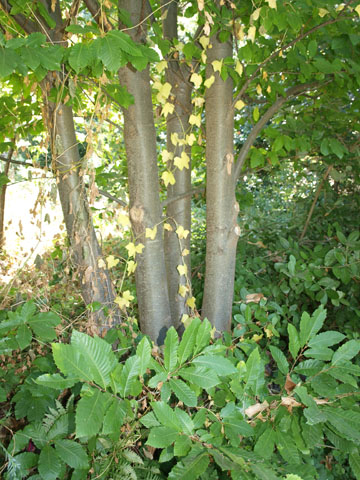
Relatively few American gardeners have even heard of coppicing and most probably don’t even know what it is. However most have probably noticed the phenomenon behind it; that when you cut down many deciduous trees (it doesn’t work with most conifers) their roots remain alive and send up a ring of vigorous new shoots (known as suckers) around the stump (known as a stool). They probably look upon this as a bad thing though, and are then interested in finding an easy way to kill the root. In my opinion this is the wrong approach, though of course it depends upon why you cut down the tree in the first place. If these stools are left alone (and not eaten by deer) the shoots (suckers) will grow rapidly and can eventually be put to use (leave them long enough and the tree will grow back).

Coppicing makes use of this ability to regenerate and gives you a way to control the size of your trees. This enables you to coexist with trees that cast a lot of shade, rather than killing them. You can simply coppice it and keep it as a shrub instead. You can even allow it to grow back into a tree at a later date, if circumstances change. If done carefully coppicing doesn’t hurt the tree at all and may actually extend its life be periodically rejuvenating it.

I should add that re-growth isn’t guaranteed; occasionally you cut a deciduous tree and it doesn’t grow back. The ability to sucker depends upon the species, the health of the tree and the size of the tree. Younger trees sprout vigorously, while the large stools of older trees sometimes rot and die.

Coppicing also provides useful products for the garden. You can cut the growing shoots whenever they reach a useful size (anywhere from 1 –30 years depending upon the species and climate) and the process will begin all over again. The wood produced has a variety of uses depending upon when it is cut. The slender shoots of willow are harvested after only one or two years for use in making baskets. Larger shoots and small poles can be cut in three to five years for garden supports, while older wood can be used for fence posts or as firewood.

Coppicing is an important forestry management tool in many parts of the world (anywhere trees aren’t abundant), because it is the best way to get maximum production of wood from an area. Unlike newly planted seedlings, the new shoots are growing from established roots, so re-growth is extremely vigorous (shoots may grow 10 feet in a season).
A Redwood stool after one year
Coppicing can also be used to control the size of shrubs, in fact it is even more reliable with them because that is how most grow naturally. When you cut shrubs down to ground level they will send up a new set of shoots that are even straighter, cleaner and better looking than the previous ones and these can be used around the garden as supports or chipped as a source of biomass for mulch.

When I built my house all of the trees and shrubs (Ceanothus, Elder, Manzanita, Coffeberry, Oak, Walnut, Chestnut and Redwood – one of the few conifers to coppice) in the immediate area of the house were cut to the ground, but most ultimately sprouted back up. This was helpful in landscaping as it gave me a nice random natural pattern of fast growing plants, which I incorporated into the garden. 

My land is fairly wooded and I have coppiced quite a few of the trees to admit more light, including several small (relatively) Redwoods. They were on the south side of the garden and seriously shading the area where I wanted to put annual vegetables. I would feel guilty about cutting down something that could potentially live 20 times as long as I will, so this was a great solution. If I leave here and someone who doesn’t like gardening moves in (which would be a shame), the redwoods can grow back again.

Here are some trees that should coppice well:
Alder, Basswood, Beech, Birch, Cherry, Chestnut, Cottonwood, Eucalyptus, Hackberry, Hickory, Honey Locust, Oak, Maple, Mesquite, Persimmon, Plum, Poplar, Redwood, Sassafras, Walnut, Willow.
 Shoots emerging from a newly cut Chestnut stool
The same stool after one years growth

Same stool after 2 growing seasons
Seven year old Chestnut coppice

Friday, February 3, 2012

Making seedling flats

My new greenhouse is getting warmer by the day (in fact I will soon have to finish the venting) and it’s time to start sowing the first spring crops inside it. I decided that a new greenhouse should have new flats to go with it (a fresh start), so I made a whole stack of them and took some pictures of the process. If you don’t already know, flats are shallow open wooden planting boxes, used for starting seeds of the easily transplanted crops, such as Brassicas, tomatoes, lettuce, onion, peppers and more.
The parts
Flats are pretty simple and there isn’t a great deal of design involved in making them. They can be any size you want, though you should make sure they are of a size that fits the wood you have without too much cutting (cutting wastes both wood and time). I found that 24 x 14 worked well with the wood I had (the four bottom boards are just under 3 ½” wide). The depth of a flat is more critical, as you need enough depth for the roots, but don’t want them to be too deep, as this makes them heavy and requires more soil mix to fill them. I find that 3 ½” is a good average depth, as well as a standard lumber dimension. Some gardeners like to have two different depths, a shallow one (3”) for starting seeds and a deeper (4”) one for pricking out. There only other important design criteria is that there should be a narrow gap between the bottom boards for good drainage.
The sides
I didn’t have to buy any material for my flats because I salvaged a lot of 1X redwood when a neighbor tore down an old fence (if ever you see a redwood or cedar fence being replaced, grab the old materials before they go to the dump). I also had some 4” X ¼” tongue and groove redwood paneling that another neighbor gave me when he was selling his house, and this was perfect for the bottoms. You can use any old wood for making flats (only buy it as a very last resort), though if it isn’t rot resistant they won’t last anywhere near as long (which is okay). I have redwood flats that have fallen apart from use and the wood is still as good as new.
Half finished
I ripped the fence boards down to a width of 3 ¼” on my table saw and cut them into 22 ½” pieces for the sides and 14” pieces for the ends. When nailed together this gave me a finished flat measuring 24” X 14”). The bottom boards were a full 24” in length. You can see from the photographs how they all go together.
Nailing the bottom
I used 1 ¼” staples (and an air stapler) to nail the flats together (because I already had them and didn’t have any nails). The gun makes the process go very quickly and with all the pieces cut I could assemble a flat in under 3 minutes (I’m guessing now, I never actually timed it). If I didn’t have the staples I would have nailed the sides together with 1 ½” galvanized common nails and attached the bottoms with ¾” galvanized common nails. I can’t think of anything else to say here, as I said before this is a pretty simple process and a picture is worth a thousand words anyway.
That was easy